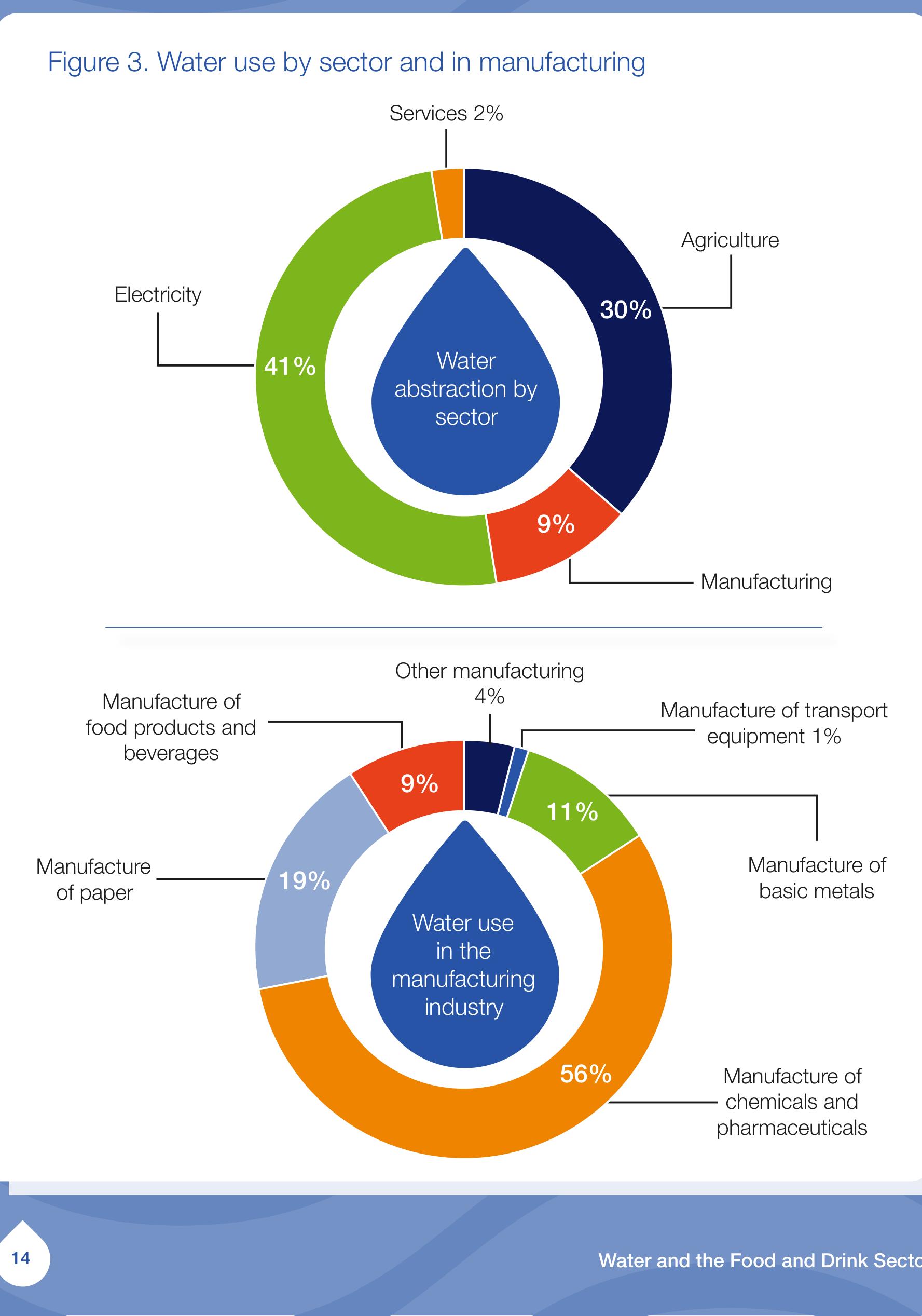
Eurostat data reveals the distribution of water abstraction across sectors and within manufacturing. At the sectoral level, agriculture accounts for the largest share of total water abstraction at 41%, followed by electricity at 30% and manufacturing at 9%. Within the manufacturing industry, water use is highly concentrated—the manufacture of chemicals and pharmaceuticals alone accounts for 56% of industrial water use, followed by basic metals (11%), paper (19%), and food products and beverages (9%). Despite its essential role in food safety and production, the food and drink sector represents a relatively small share of both total water abstraction and manufacturing water use.Data source: Eurostat
EU Water Abstraction by Sector and Manufacturing Sub-Sector
| Sector / Sub-Sector |
Share of Total Abstraction |
Share of Manufacturing Use |
| Agriculture |
41% |
— |
| Electricity |
30% |
— |
| Manufacturing (total) |
9% |
100% |
| — Chemicals and pharmaceuticals |
~5.0% |
56% |
| — Paper |
~1.7% |
19% |
| — Basic metals |
~1.0% |
11% |
| — Food products and beverages |
~0.8% |
9% |
| — Transport equipment |
~0.1% |
1% |
| Services |
2% |
— |
Note: Manufacturing sub-sector shares are calculated as percentages of manufacturing water use, not total abstraction. Sector percentages may not sum to 100 due to rounding and omitted categories. Data source: Eurostat.
Data source: Eurostat
From the water use distribution data, three key observations emerge:
Agriculture dominates total water abstraction at 41%, but manufacturing accounts for only 9%. Agriculture is the largest water user by a significant margin, more than double electricity generation (30%) and more than four times manufacturing (9%). This distribution reflects the structural reality of Europe's water economy—while food processing plays a critical role in food safety and consumer health, its direct water footprint is small relative to primary agricultural production. However, the report notes that "direct water footprint" does not capture the sector's full exposure, as food processors depend on water-reliant agricultural inputs.
Chemicals and pharmaceuticals dominate manufacturing water use at 56%. Within manufacturing, water use is extremely concentrated—chemicals and pharmaceuticals alone use more water than all other manufacturing sub-sectors combined (56% vs. 44%). This is primarily due to large-volume cooling water requirements in chemical production. In contrast, food and beverage production accounts for only 9% of manufacturing water use, placing it fourth among manufacturing sub-sectors behind chemicals (56%), paper (19%), and basic metals (11%).
Food and drink accounts for approximately 0.8% of total EU water abstraction. Based on the 9% manufacturing share and 9% food share within manufacturing, the food and drink sector represents roughly 0.8% of total EU water abstraction. This aligns with the report's figure of 1.8% for the sector's total water use (excluding agriculture). Despite this modest share, the sector faces high exposure to water-related risks due to two factors: reliance on agricultural inputs from water-stressed regions, and stringent water quality requirements for food safety compliance. This combination—small direct footprint but high indirect vulnerability—explains the report's focus on supply chain collaboration with agriculture.
6. Report Download
Download the full report: Water and the Food and Drink Sector: Building a resilient and sustainable future

Eurostat data reveals the distribution of water abstraction across sectors and within manufacturing. At the sectoral level, agriculture accounts for the largest share of total water abstraction at 41%, followed by electricity at 30% and manufacturing at 9%. Within the manufacturing industry, water use is highly concentrated—the manufacture of chemicals and pharmaceuticals alone accounts for 56% of industrial water use, followed by basic metals (11%), paper (19%), and food products and beverages (9%). Despite its essential role in food safety and production, the food and drink sector represents a relatively small share of both total water abstraction and manufacturing water use.Data source: Eurostat




 原图定位
原图定位