
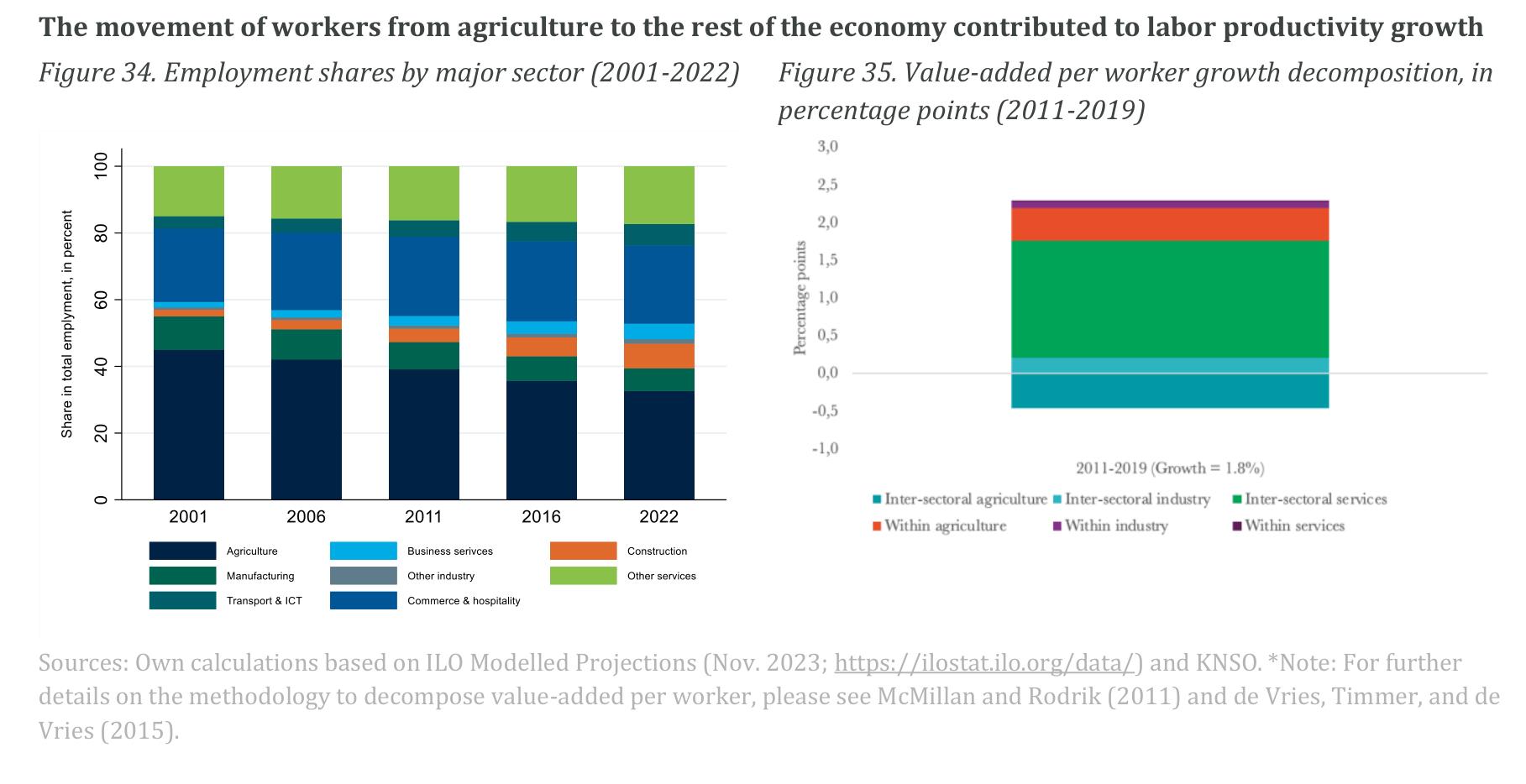
Overall, structural change positively contributed to labor productivity growth, with services inter- This is a common feature in low-income countries, where the reallocation component explains the majority of labor productivity growth. However, within sector gains were small for Kenya, following a different trend than middle-income countries. This suggests that firms and industries are not becoming much more efficient internally due to limited technological upgrading, weak innovation, Overall, the above-mentioned fiscal and external constraints also shaped the evolution of productivity at the worker, sector, and firms' level; profits and wages seem to be declining over time. Real wages declined by 12.8 percent between 2019 and 2023 and only grew by 2.1 Wage growth in the public sector was significantly higher than in the private sector. Relative, drawing in higher-skilled workers which could, otherwise, be available to work in the private sector. Mincer regressions confirm high wage premiums to education in Kenya, which reached up to 167 percent possess (World Bank, 2023e). Moreover, the continuous pre-COvID real appreciation may have distorted local labor markets. The relative loss of competitiveness in tradable sectors also seemed to have biased the economy towards more new jobs created in non-tradable services and construction, which could have misallocated labor and capital given their relative success; as a consequence, businesses' profits have come under pressure, and several international businesses have exited the country citing an unfavorable business environment. 27 Labor productivity gains within sectors are explained by capital accumulation, technological change, or a reduction in resource misallocation (of capital or labor) (McMillan and Rodrik, 2011)




 原图定位
原图定位