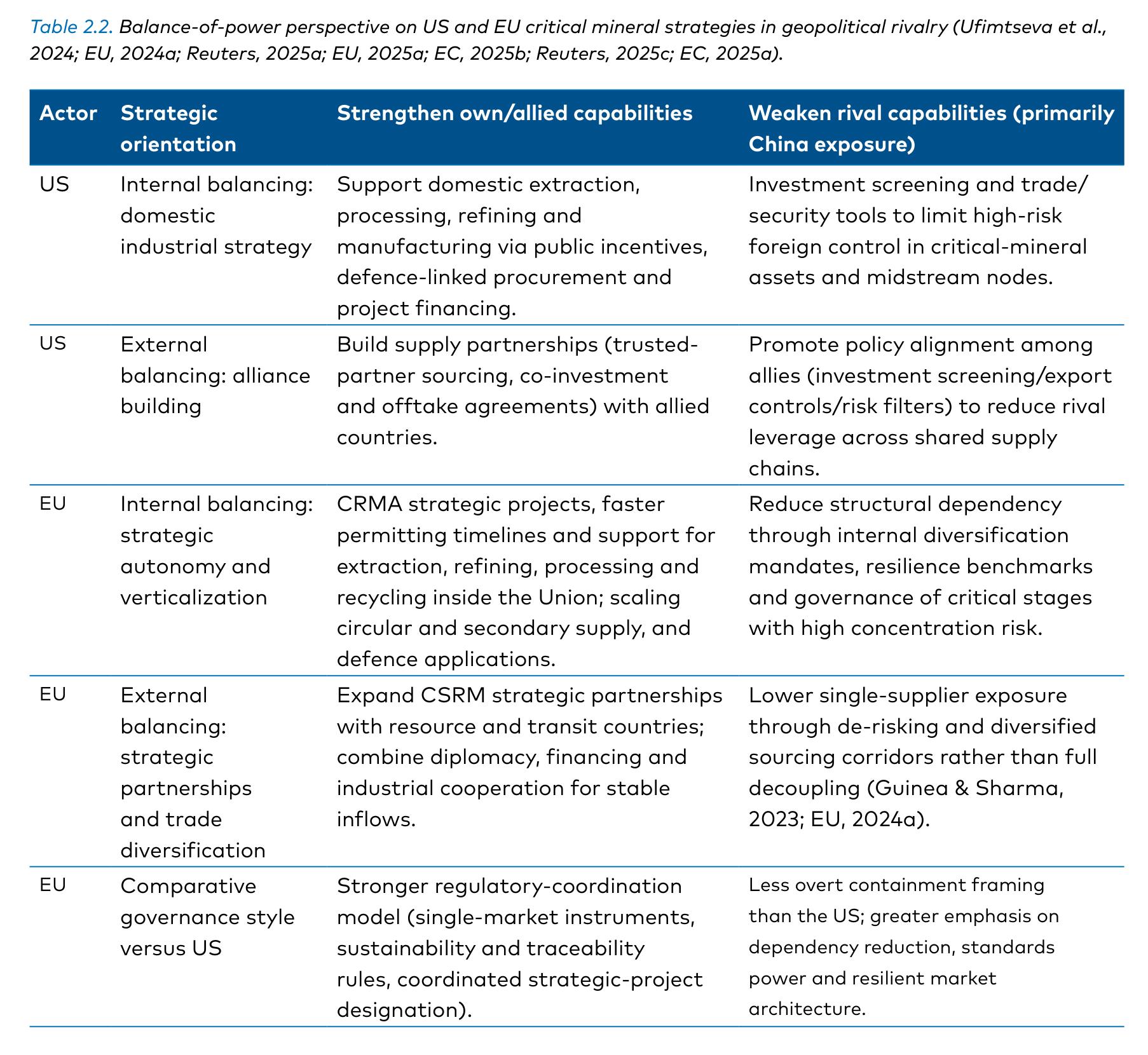
Nordic Innovation report compares US and EU critical mineral strategies through a balance-of-power lens. Both actors pursue dual-track internal and external balancing, but with distinct emphases and governance models. The US strategy combines domestic industrial policy (public incentives, defence-linked procurement, project financing) with alliance building (trusted-partner sourcing, co-investment). The EU strategy emphasizes "strategic autonomy" and verticalization—through CRMA strategic projects, faster permitting, and internal processing and recycling—while pursuing external diversification through strategic partnerships. The EU's governance model differs from the US through stronger regulatory coordination (single-market instruments, sustainability rules) and a greater emphasis on dependency reduction rather than overt containment.Data source: Ufimtseva et al. (2024), EU (2024a), Reuters (2025a), EU (2025a), EC (2025b)
US and EU Critical Mineral Strategies Comparison — Balance-of-Power Perspective
| Actor |
Strategic Orientation |
Strengthen Own/Allied Capabilities |
Weaken Rival Capabilities (primarily China exposure) |
| US |
Internal balancing:
domestic industrial strategy |
Support domestic extraction, processing, refining and manufacturing via public incentives, defence-linked procurement and project financing. |
Investment screening and trade/security tools to limit high-risk foreign control in critical-mineral assets and midstream nodes. |
External balancing:
alliance building |
Build supply partnerships (trusted-partner sourcing, co-investment and offtake agreements) with allied countries. |
Promote policy alignment among allies (investment screening/export controls/risk filters) to reduce rival leverage across shared supply chains. |
| EU |
Internal balancing:
strategic autonomy and verticalization |
CRMA strategic projects, faster permitting timelines and support for extraction, refining, processing and recycling inside the Union; scaling circular and secondary supply, and defence applications. |
Reduce structural dependency through internal diversification mandates, resilience benchmarks and governance of critical stages with high concentration risk. |
External balancing:
strategic partnerships and trade diversification |
Expand CSRM strategic partnerships with resource and transit countries; combine diplomacy, financing and industrial cooperation for stable inflows. |
Lower single-supplier exposure through de-risking and diversified sourcing corridors rather than full decoupling. |
| Comparative governance style versus US |
Stronger regulatory-coordination model (single-market instruments, sustainability and traceability rules, coordinated strategic-project designation). |
Less overt containment framing than the US; greater emphasis on dependency reduction, standards power and resilient market architecture. |
Data source: Ufimtseva et al. (2024), EU (2024a), Reuters (2025a), EU (2025a), EC (2025b)
From the US and EU critical mineral strategy comparison, three key observations emerge:
Both the US and EU pursue dual-track balancing, but with different emphases. The US focuses on public incentives and defence-linked procurement for internal strengthening, and trusted-partner alliances with allied countries for external balancing. The EU's internal strategy emphasizes "strategic autonomy" through CRMA strategic projects, faster permitting, and vertical integration across the value chain. The EU's external strategy focuses on lowering single-supplier exposure through de-risking and diversified sourcing corridors rather than full decoupling. As the report notes, "the decisive question is therefore not only whether the Nordic countries can mine more, but whether selective trade diversification and chain completion can be achieved under realistic timelines, capital constraints, permitting requirements and ESG conditions."
The EU relies more heavily on regulatory coordination and standards power. The EU's governance model features stronger regulatory-coordination mechanisms: single-market instruments, sustainability and traceability rules, and coordinated strategic-project designation. By contrast, the US more heavily relies on investment screening, export controls, and risk filters—direct intervention tools. This reflects the different institutional structures of the two actors—the EU as a rules-based supranational entity is better positioned to shape supply chain environments through standards and regulation, while the US as a sovereign state can deploy more direct trade and security instruments.
The EU's approach to rival capability reduction is structural rather than confrontational. The EU's approach to reducing rival capabilities emphasizes "dependency reduction, standards power and resilient market architecture" rather than overt containment. The US, in contrast, directly employs investment screening and trade/security tools to "limit high-risk foreign control in critical-mineral assets and midstream nodes." The EU's structural de-risking approach—through internal diversification mandates and resilience benchmarks—aligns with the CRMA's 2030 targets (10% domestic extraction, 40% processing, 25% recycling) as a framework for reducing single-supplier exposure without explicit decoupling. This distinction is central to understanding how the Nordic region can position itself within EU strategic frameworks—as a trusted partner for supply diversification rather than as part of a containment strategy.

Nordic Innovation report compares US and EU critical mineral strategies through a balance-of-power lens. Both actors pursue dual-track internal and external balancing, but with distinct emphases and governance models. The US strategy combines domestic industrial policy (public incentives, defence-linked procurement, project financing) with alliance building (trusted-partner sourcing, co-investment). The EU strategy emphasizes "strategic autonomy" and verticalization—through CRMA strategic projects, faster permitting, and internal processing and recycling—while pursuing external diversification through strategic partnerships. The EU's governance model differs from the US through stronger regulatory coordination (single-market instruments, sustainability rules) and a greater emphasis on dependency reduction rather than overt containment.Data source: Ufimtseva et al. (2024), EU (2024a), Reuters (2025a), EU (2025a), EC (2025b)


 原图定位
原图定位