
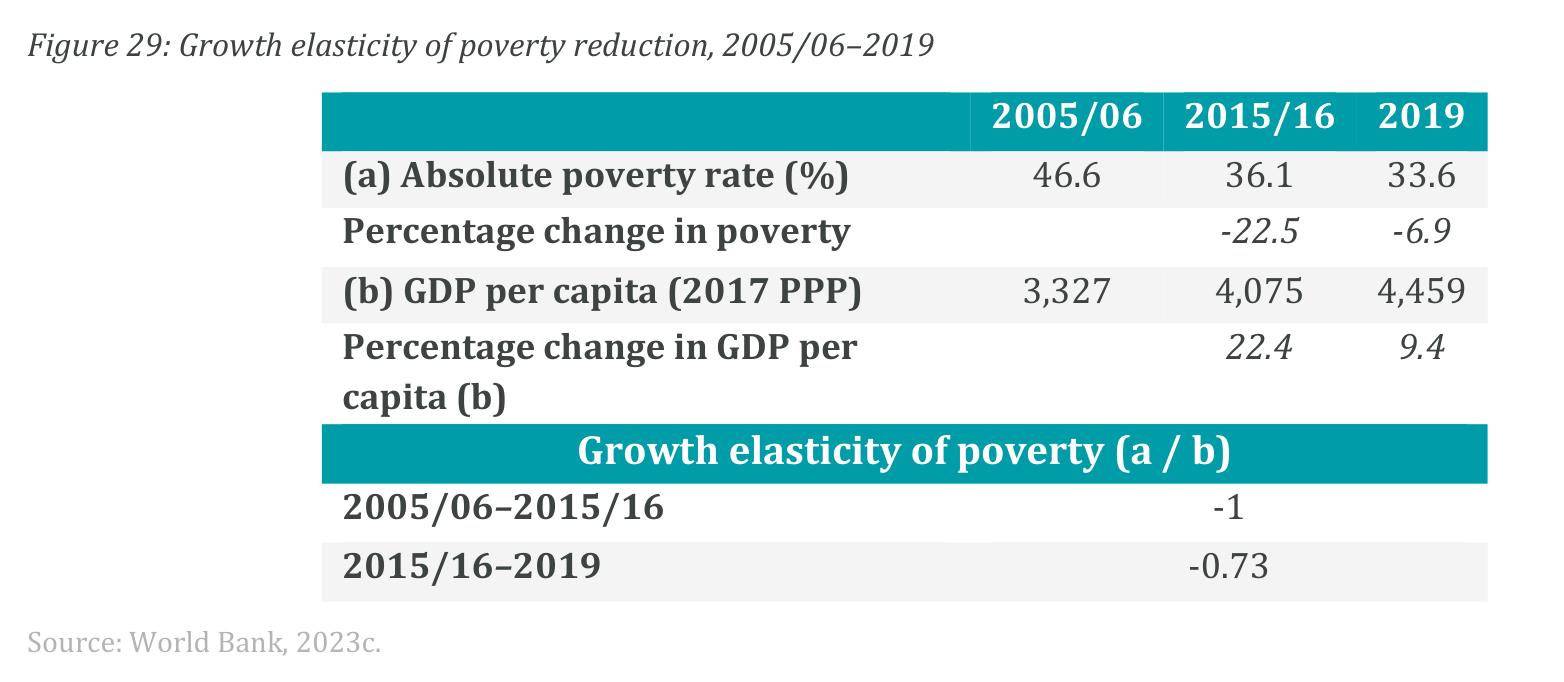
investment-led strategy are at the center of this. The country needs to add more value to its exports and become more competitive, at the same time it needs to attract more foreign direct investment. knowhow would spur business and job creation, pushing productivity and growth. The pace of poverty reduction slowed during the second half of the 2010s, with most of the gains reverted by the CoVID-19 pandemic. The annual reduction of the poverty rate started to decrease by 2015 and stood at -0.6 coincided with an even higher average GDP per capita growth of 2.5 percent. Thus, the response of pandemic begun, the poverty rate rose by 9.3 percentage points to 42.9 percent, reversing over 70 percent of the gains in poverty reduction since 2o05. Household consumption fell both within rural and urban areas, and although poverty is concentrated in rural areas, the poverty rate in urban areas to 38.6 percent in 2021. Currently, there are now more than twice as many urban poor than in increased incomes, but few low-skilled workers (the majority of Kenya's workforce) are 19 The number of poor in rural areas reached 13.7 million in 2021, falling from 14.1 million in 2005/06. In urban areas, the number of poor increased from 2.4 million in 2005/06 to 5.4 million in 2021.


 原图定位
原图定位