
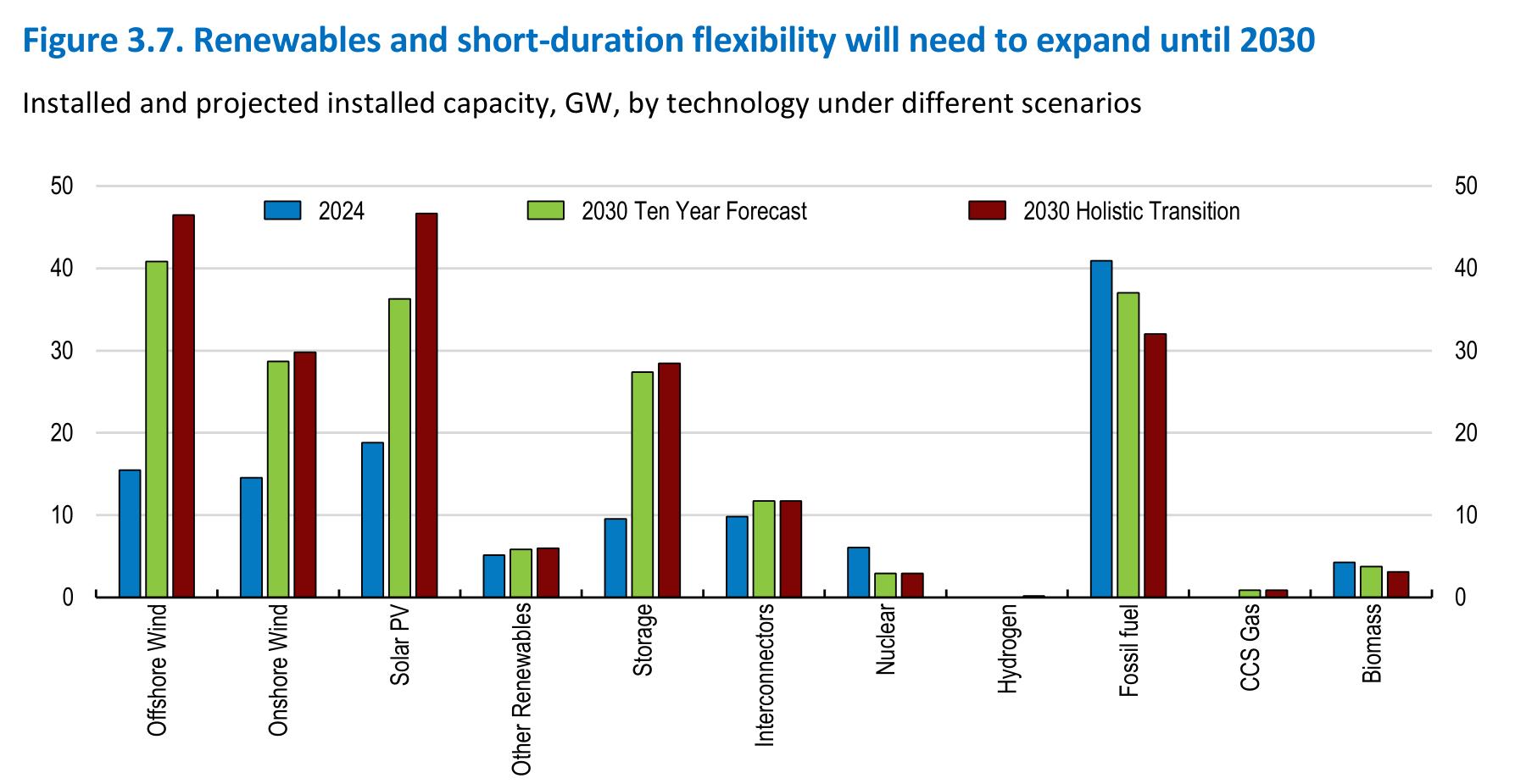
Even with timely grid reinforcement, system reliability under the Clean Power Plan 2030 objective will depend on the ability to balance demand and supply in real time. As renewable generation increases, managing short- term fluctuations and longer stress periods becomes a central pillar of energy security and affordability. Short peak imbalances, such as intraday fluctuations in wind and solar output, can be managed through demand- side flexibility and short-duration battery storage. By contrast, longer stress periods, such as cold winter weeks when generation might be low and demand high, require a sequence of responses, including demand (NESO, 2025[15]). Ensuring that these flexibility options scale in line with renewable expansion is central to Under current project timelines and system projections, nuclear capacity and large scale long-duration storage decade will therefore depend primarily on renewable expansion, short-duration flexibility, interconnection duration storage remain important components of the longer-term system architecture (see below), they will technology deployment rates, and expected electrification-driven demand growth, rather than the fullrange of long-term net-zero scenarios. In the sasn iesnpu punoe pasn uie aopy ym uaopu pue uoeal jo xiu e yano a s! oaz iau uans uoisu o Hydrogen is not used forheat except as a secondaryfuelforheat networks in small quantities. Consumer engagement is very strong through adoption of energy efficiency improvements and demand shifting, with smart homes and electric vehicles providing flexibility. A high-renewable capacity pathway, with unabated gas dropping sharply. Pathway sees moderate levels of nuclear capacity and lowest levels of hydrogen dispatchable power. Supply-side flexibility is high, delivered through electricity storage and interconnectors. No unabated gas remains on the network in 2050. Source: NESO 2025, Future Energy Scenarios. StatLink 显is https://stat.link/opwmad OECD ECONOMIC SURVEYS: UNITED KINGDOM 2026 ? OECD 2026


 原图定位
原图定位