Investment Policy Classification Framework: Full Spectrum of Pro-Investor and Restrictive Measures
2026-07-10 08:30:00
1
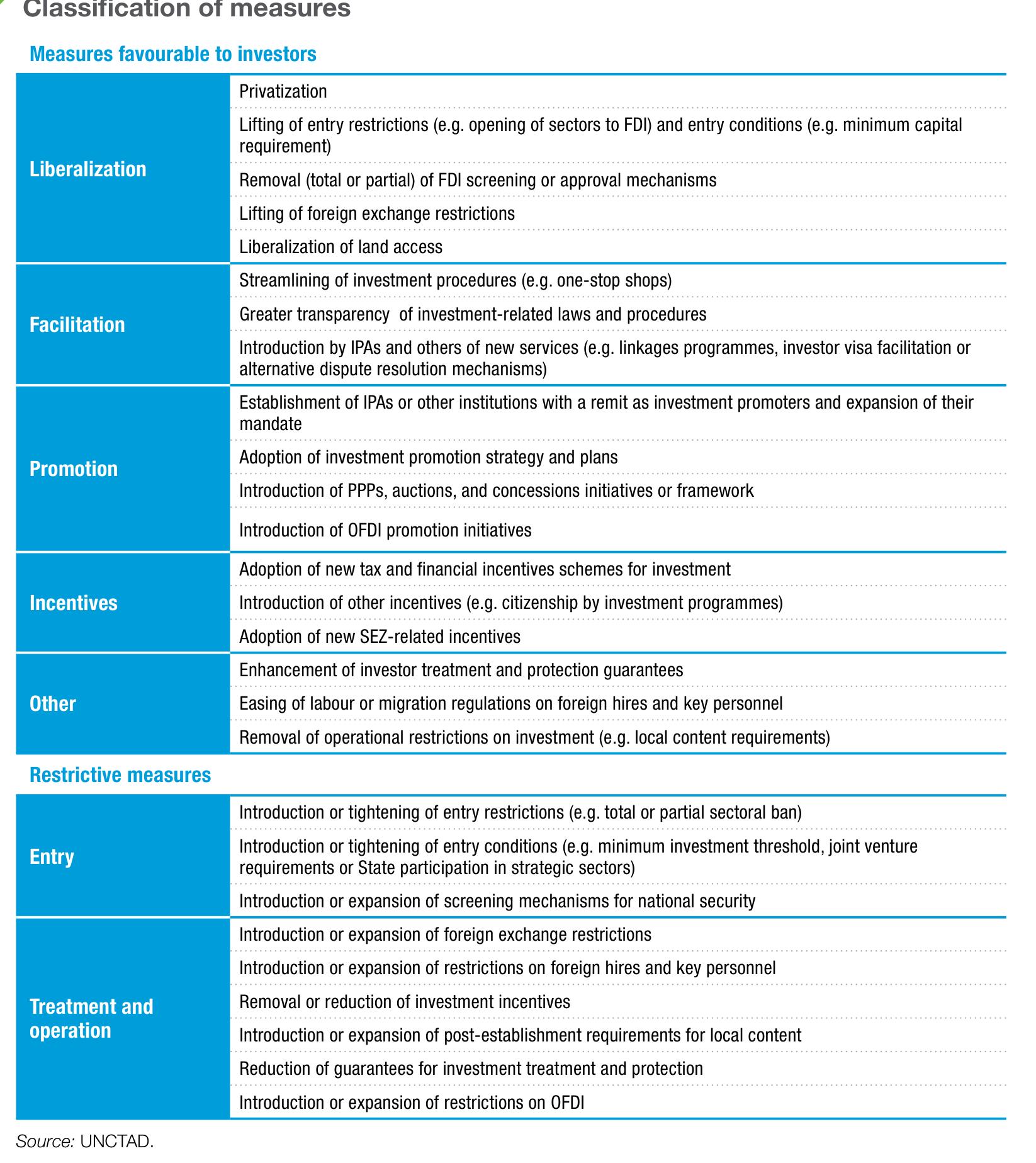


| Main Category | Sub-Category | Specific Policy Instruments |
|---|---|---|
| Measures favourable to investors | Liberalization | Privatization; Lifting of entry restrictions (e.g. opening of sectors to FDI) and entry conditions (e.g. minimum capital requirement); Removal (total or partial) of FDI screening or approval mechanisms; Lifting of foreign exchange restrictions; Liberalization of land access |
| Facilitation | Streamlining of investment procedures (e.g. one-stop shops); Greater transparency of investment-related laws and procedures; Introduction by IPAs and others of new services (e.g. linkages programmes, investor visa facilitation or alternative dispute resolution mechanisms) | |
| Promotion | Establishment of IPAs or other institutions with a remit as investment promoters and expansion of their mandate; Adoption of investment promotion strategy and plans; Introduction of PPPs, auctions, and concessions initiatives or framework; Introduction of OFDI promotion initiatives | |
| Incentives | Adoption of new tax and financial incentives schemes for investment; Introduction of other incentives (e.g. citizenship by investment programmes); Adoption of new SEZ-related incentives; Enhancement of investor treatment and protection guarantees; Easing of labour or migration regulations on foreign hires and key personnel; Removal of operational restrictions on investment (e.g. local content requirements) | |
| Other | Enhancement of investor treatment and protection guarantees; Easing of labour or migration regulations on foreign hires and key personnel; Removal of operational restrictions on investment (e.g. local content requirements) | |
| Restrictive measures | Entry | Introduction or tightening of entry restrictions (e.g. total or partial sectoral ban); Introduction or tightening of entry conditions (e.g. minimum investment threshold, joint venture requirements or State participation in strategic sectors); Introduction or expansion of screening mechanisms for national security; Introduction or expansion of foreign exchange restrictions; Introduction or expansion of restrictions on foreign hires and key personnel |
| Treatment and operation | Removal or reduction of investment incentives; Introduction or expansion of post-establishment requirements for local content; Reduction of guarantees for investment treatment and protection; Introduction or expansion of restrictions on OFDI |


 原图定位
原图定位