
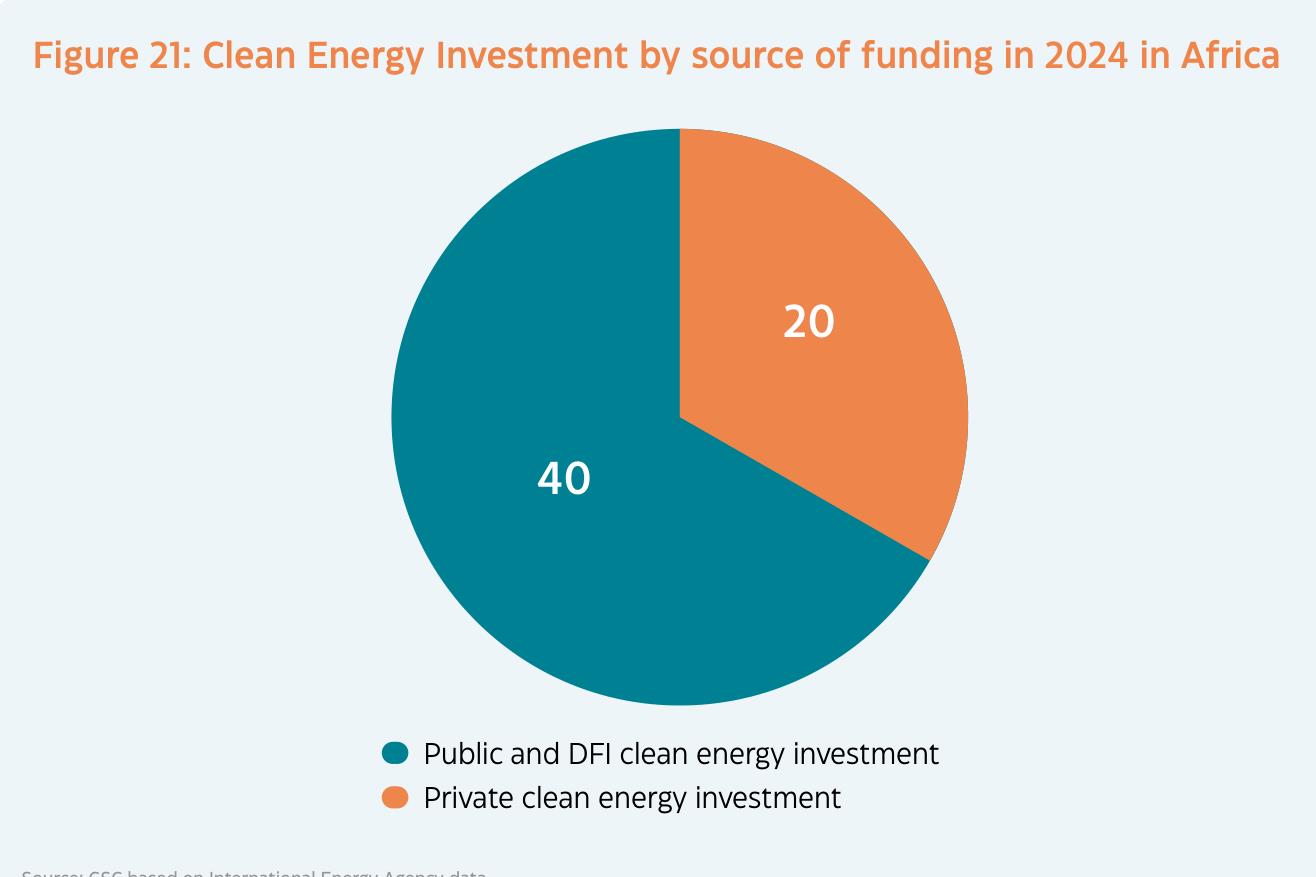
Furthermore, investment have been unevenly distributed across the continent. According to the IRENA, the 33 least developed countries in Africa received only 37% of the renewable energy commitments in the continent, over 2010-2019, and their share has since declined unable to attract private finance. The risk is creating a continent with a “happy few", whereas a tripled, increasing from about USD 17 billion Nonetheless, we can observe a declining public finance funding throughout the world. Therefore, achieve all their energy-related development goals9 . offering long-term sustainable returns. This trend is true at the global level, where private investment has outpaced public funding in climate finance for the first timeloo. This investment is crucial for economic growth, reducing fossil fuel dependence, and building climate resilience against severe impacts, leveraging Africa's vast natural potential. However, elevated risk perceptions, a shortage of bankable projects, and developing financiall systems frequently discourage private investors, constraining the scale-up of renewable energy initiatives. The African region has a WACC, to the point where the cost of capital can be three to five times higher in Africa than in so-called “developed" countries'01. In fact, if Sub-saharan Africa had a CoC equivalent to that of Europe throughout the period from 2024 to 2050, the region's solar PV capacity would be 20% higher. This high cost of capital is keeping African countries in a spiral of underinvestment. Despite this progress in private investment, the numbers do not tally. The challenge remains: systemic economic transformation, opening new pathways for distributed solar, and existing and innovative financing mechanisms, opening climate finance to new possibilities will be crucial in delivering on Africa's renewables objectives.


 原图定位
原图定位