
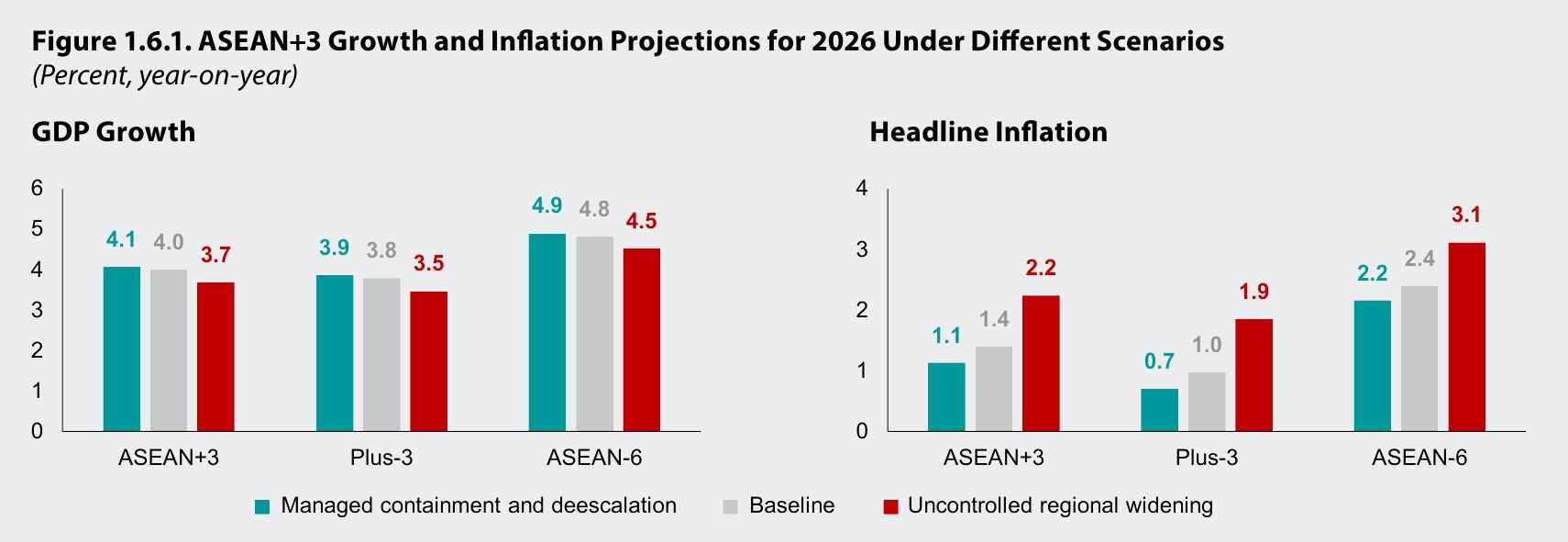
Chapter 1. Macroeconomic Prospects and Challenges scenario, the conflict remains contained, with relatively quick deescalation, as parties involved in Baseline: Protracted attritional conflict. Conflicts achieved. Oil and gas transit through the Strait of retaliation, with disruptions persisting for several months. Movement through the straits of Hormuz start of the conflict. Oil prices to stay above USD 90 remains impaired, as elevated security threats lead to intermittent passage and partial closures, tightening effective global oil supply. Oil prices are assumed to as markets priced in reduced risk. In this scenario, 1.1 percent, with growth to be slightly higher at tensions gradually ease. The oil price trajectory under contracts2. Under this scenario, ASEAN+3 growth and episodes, supported by improved energy effciency, inflation in 2026 are forecast to be 4.0 percent and Uncontrolled regional widening. In this scenario, strategic petroleum reserves among Plus-3 economies. infrastructure, severely disrupting oil and gas production. Shipping disruption also intensifies, increases, particularly through lower dependence triggering a prolonged closure of the Strait of Hormuz. on fossil fuels in the transport sector. Nonetheless, markets. Oil prices to sustain above USD 100 per barrel to the region's energy security since 2022. Unlike for the remainder of 2026, alongside tighter financial previous disruptions,it directly threatens the maritime activity globally. In this scenario, ASEAN+3 inflation is energy imports flow, and the ultimate impact on the expected to rise above 2 percent in 2026, its highest level since 2022, while growth is expected to slow to 3.7 Simulations are run using Oxford Economics' Global Economic Model (GEM), a multi-country macroeconometric model which covers 80 economies interlinked state after a shock to its independent variable, thus capturing both the short- and long-term effects, with integrated cross-country linkages transmitting shocks prices adjust fully and outcomes are pinned down by supply-side fundamentals (productivity, labor, and capital).For this exercise, only the short-term estimates are






![满足AI推理需求所需的计算资源规模(以吉瓦计)[9]](https://file.sgpjbg.com/FileUpload1/News/2a923cfb-8dea-43d4-9114-4097f1972f49.png "满足AI推理需求所需的计算资源规模(以吉瓦计)[9]")
 原图定位
原图定位