
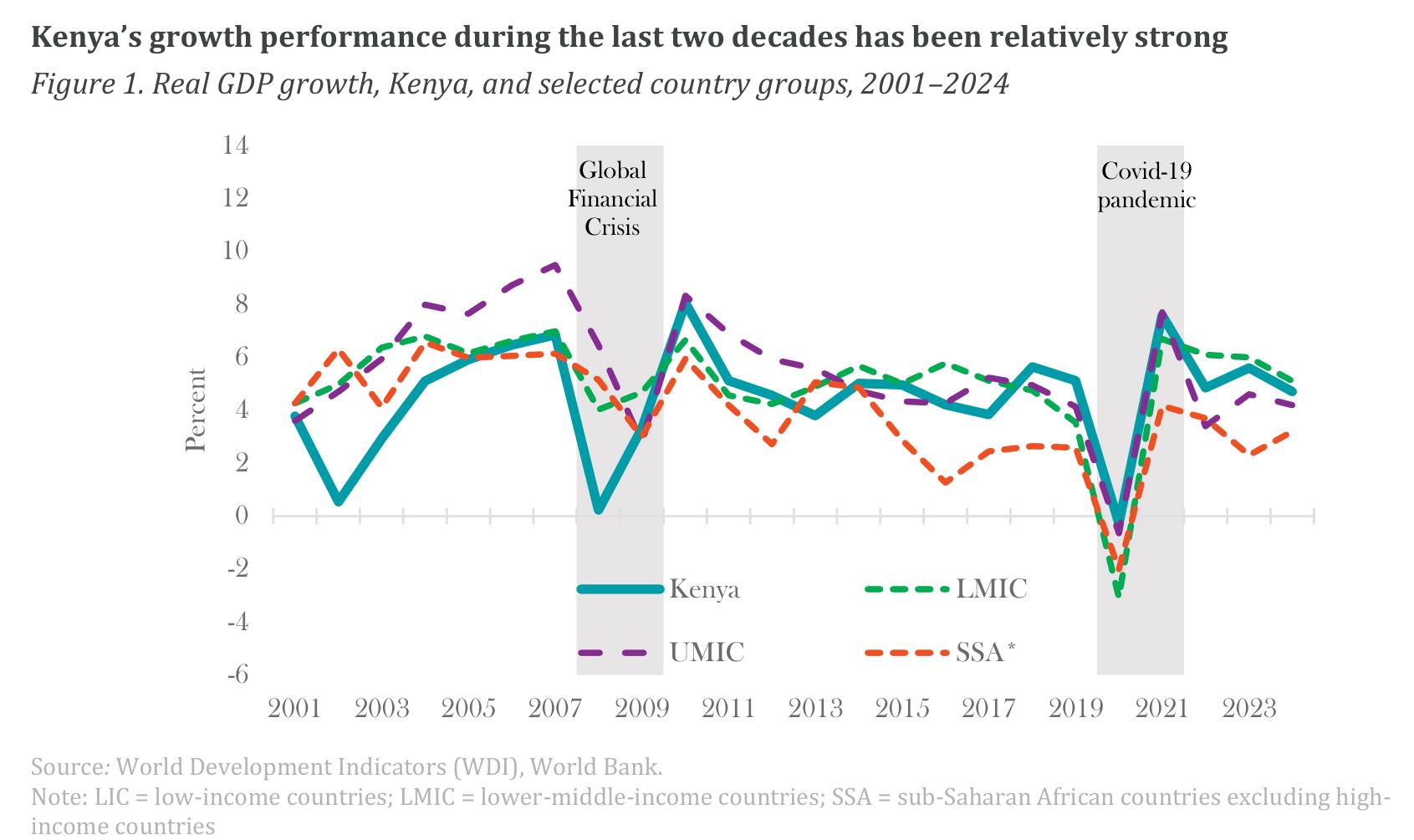
To sustain economic growth, reduce poverty and make economic gains more inclusive, Kenya needs to address pressing structural challenges. Kenya recorded solid and sustained economic growth rates during the last two decades, which translated into increased incomes, poverty reduction, and improved well-being to its citizens. Real gross domestic product (GDP) grew at an average rate of 4.5 percent between 2001 and 2025. income-level and sub-Saharan African (SSA) averages, the country was able to sustain these growth poverty reduction, especially between 2005 and 2015, where more than 200,000 Kenyans escaped economic growth, particularly in rural areas, and thus inequality also decreased.5 Access to basic services also improved, including enhanced water sources, rising access to electricity, and increased 4 The poverty headcount fel from 46.7 percent to 36.1 percent between 2005 and 2015, a 1.1 percentage points per year decrease, on average, meaning that around 210,545 less Kenyans were below the poverty line. These years coincides with a period of robust GDP per capita growth of 2.0 percent per year, along with a strong growth in private consumption, which grew at an average rate of 2.3 percent


 原图定位
原图定位