
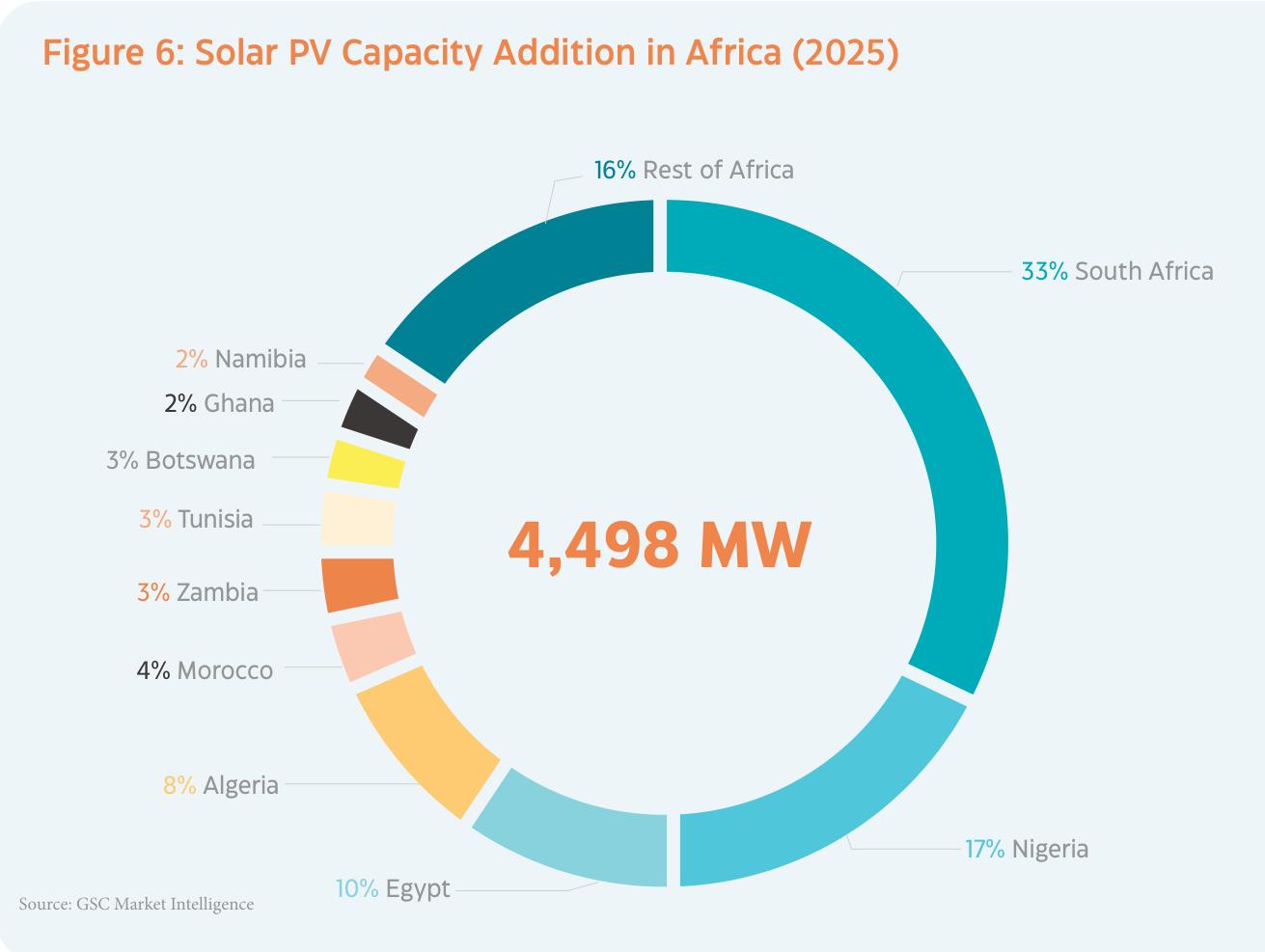
had less than 5 MW of installed solar PV capacity in 2025. This suggests a continent moving at two speeds, rather than one dominated by just two or three leading markets as in the past. Sao Tome and Principe or Guinea-Bissau, which naturally have lower demand for large-scale capacity. In addition, several of these countries rely more heavily on distributed solar, which and point to significant untapped potential. Libya, for example, commissioned its first-ever 1 MW solar power plant in 2025, an important milestone that opens the door to larger future projects and highlights the diverse dynamics at play across the continent. On the other hand, this diversification takes place during an unprecedented growth of the market, meaning that this effort is more and more collective. Indeed, while traditional champions remain such as South Africa and Egypt, the latter has seen a decrease from 24% to the 17% in its market share. This is due to the fact that the country has installed 2o0 Mw less compared Last year, we announced that 18 countries were poised to go above 10o Mw of installation in 10 countries have reached that threshold, representing a significant increase compared to last year. Indeed, Algeria, Morocco, Nigeria, Tunisia, Zambia, Egypt, South Africa and Botswana are part of the 100 MW-club. Ghana (92 MW) and Chad (86 MW) were close to making it. Last year, only Egypt, South Africa and Zimbabwe were above the 100 Mw threshold, with Zambia at 83 MW and Burkina Faso at 87 MW, so 5 close. This means there are twice as many countries as last In terms of market share, it is worth noting that the diversification trend observed last year is continuing. Comparing the market shares of 2024 and 2025 helps highlight two key factors that are driving the diversification of the African solar market. The solar PV market share of South Africa, the traditional leader in solar PV capacity of the overall installation across the continent. Nonetheless, this decline is not as significant as the one we have seen in 2023 to 2024, as installation in South Africa in 2023 had reached a peak, notably as a response to grid instability, therefore accounting for a 79% of the market at that time. At the same time, the share of the “Rest of Africa" increased from 8% to 16% in 2025, indicating deployment. That said, the Global Solar Council's market intelligence still shows that 24 countries



 原图定位
原图定位