The DPlIT-NCAER assessment also highlights significant disparities across firms, underscoring the Small firms incur logistics costs of up to ~16.9%22 of output, reflecting limited scale and bargaining power Large firms operate at ~7.6%23, benefiting from scale efficiencies and better access to integrated logistics Logistics Parks, the benefits remain unevenly distributed across regions and industry segments. As a result, logistics inefficiencies continue to impact delivery reliability, working capital through higher inventory buffers, and overall export competitiveness for India's chemical manufacturers. chains for critical raw materials, particularly petrochemical derivatives and specialty inputs. intermediates. Despite strong domestic demand imbalance, with a chemical trade deficit estimated at approximately $31 billion (2025)24, underscoring and expanding downstream capabilities, the At a structural level, India remains significantly dependent on imported petrochemical intermediates and key feedstocks, exposing the industry to global supply-chain disruptions and price volatility. A critical dimension of this vulnerability is the concentration of sourcing geographies. India imports a substantial share of its chemical intermediates from a limited set of regions, particularly China and parts 24. Niti Aayog, Chemical Industry: Powering India's participation in Global Value Chains June 2025 25. hemical and petrochemical statistics at a glance-2024 @ 2026 KPMG Advisory Services Private Limited, a Private Limited Company and a member firm of the KPMG global organization of independent member firms affiliated with KPMG International Limited, a private English company limited by guarantee. All rights reserved.

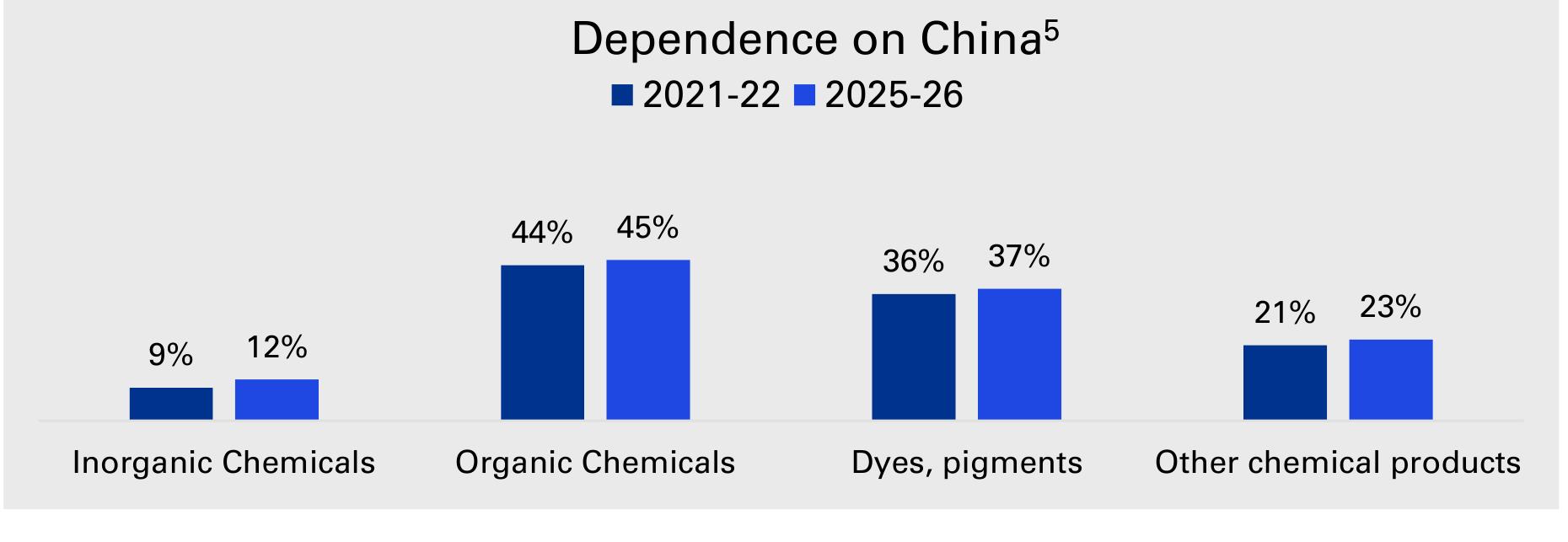
The DPlIT-NCAER assessment also highlights significant disparities across firms, underscoring the Small firms incur logistics costs of up to ~16.9%22 of output, reflecting limited scale and bargaining power Large firms operate at ~7.6%23, benefiting from scale efficiencies and better access to integrated logistics Logistics Parks, the benefits remain unevenly distributed across regions and industry segments. As a result, logistics inefficiencies continue to impact delivery reliability, working capital through higher inventory buffers, and overall export competitiveness for India's chemical manufacturers. chains for critical raw materials, particularly petrochemical derivatives and specialty inputs. intermediates. Despite strong domestic demand imbalance, with a chemical trade deficit estimated at approximately $31 billion (2025)24, underscoring and expanding downstream capabilities, the At a structural level, India remains significantly dependent on imported petrochemical intermediates and key feedstocks, exposing the industry to global supply-chain disruptions and price volatility. A critical dimension of this vulnerability is the concentration of sourcing geographies. India imports a substantial share of its chemical intermediates from a limited set of regions, particularly China and parts 24. Niti Aayog, Chemical Industry: Powering India's participation in Global Value Chains June 2025 25. hemical and petrochemical statistics at a glance-2024 @ 2026 KPMG Advisory Services Private Limited, a Private Limited Company and a member firm of the KPMG global organization of independent member firms affiliated with KPMG International Limited, a private English company limited by guarantee. All rights reserved.




 原图定位
原图定位