
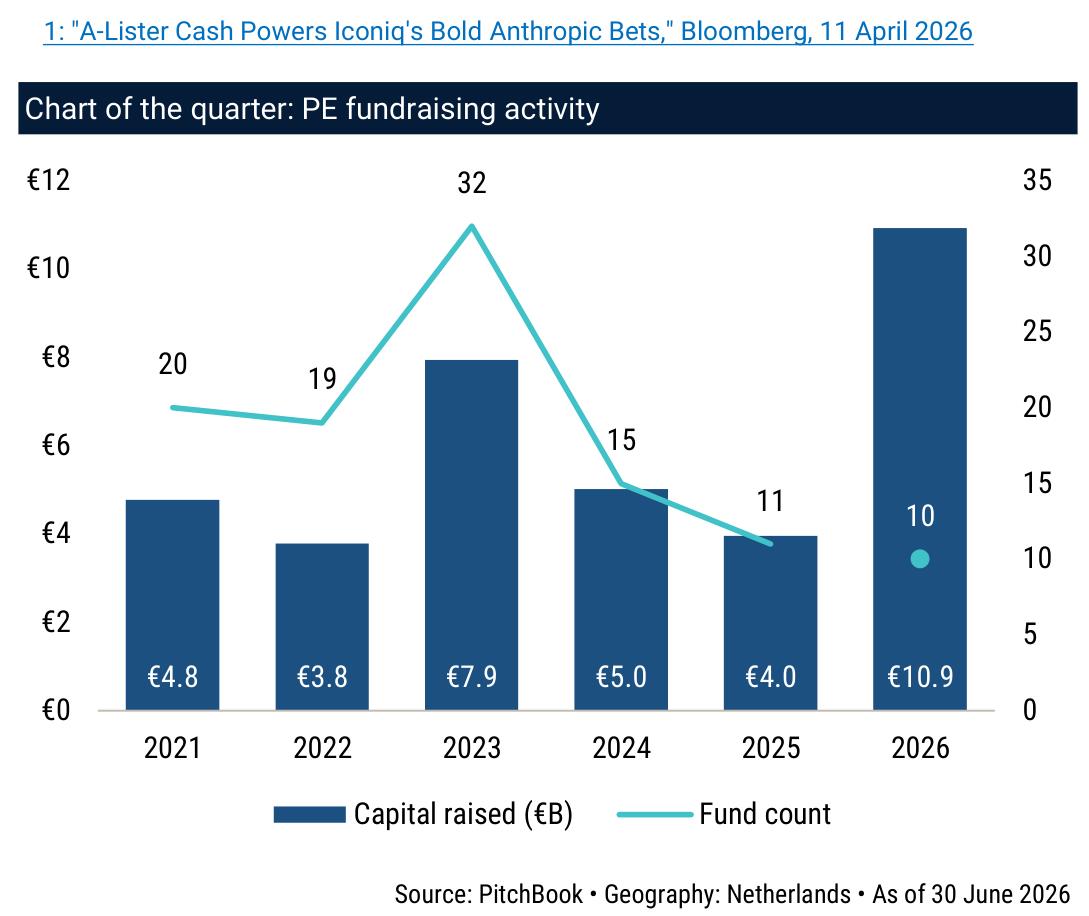
Our Country Snapshot series provides an overview of financing market trends in the region, covering various countries across Europe. We look at how both public and private data points have trended in Q2 for the Netherlands. Highlights include: In Q2 2026, the Dutch economy carried forward the modest expansion seen in Q1, when GDP grew by 0.2% QoQ, with public consumption and basis: The index returned 13.5% YTD, ahead of the STOXX Europe 600 500 (+i0.2%). Shell shares were down over the quarter as the company available, but leading indicators, including improving consumer and producer confidence, point to continued, if modest, growth. Inflation temporarily suspended its share buyback programme. ING was a standout eased through the quarter, with headline CPl slowing to 2.9% in June, on the other side, with the shares reaching a new high in June as the bank down from 3.5% in May, largely on softer motor fuel and transport costs. The labour market remained tight, with unemployment holding at 3.9% in stake in Spain's Singular Bank. Elsewhere, Prosus shares continued to May, still among the lowest in the EU, even as employment edged lower. underperform, trading around 40 by early July, still well below the roughly In currency markets, the euro weakened against the US dollar over the mid-June, as a hawkish Federal Reserve, which held rates at 3.5% to 3.75% on 17 June, met a European Central Bank that delivered its first rate hike since 2023, raising the deposit rate by 25 basis points to 2.25% Holding listed on Nasdaq on 1 April, achieving a valuation of 563.8 The Netherlands' outsized fundraising is not a one-off; it reflects a VC deal value continued to improve through 2026 with over 1.2 billion in structural shift underway in the allocation of Dutch institutions. The deal value closed across 87 deals. This was led by a flurry of late-stage country's pension funds, among the largest and most influential in Europe, VC deals. Nearfield Instruments secured E328.3 million in its Series D funding, making the company one of the Netherlands' 10 unicorns. alternative assets, PE included. In an interview with Going Private, Patrick Exit activity remained somewhat subdued in the Netherlands, led by a Kanters, CIO of Private Investments at APG Asset Management, said he and was sold to Ew Group in January for 250 million. allocation from around 26% to around 30% over the next five years, VC fundraising continued its downward trajectory in 2026, mirroring including.a PE increase in asset allocation from 6% to 8%.1 APG is far from alone in this shift: Dutch pension reform has been steadily redirecting trends elsewhere in Europe. Dry powder in Dutch vC has been falling since peaking in 2024, as investors turn more risk-averse toward the capital towards private markets across the system, giving homegrown asset class. Dutch pre-seed firm DFF Ventures has just announced the close of its third fund, DFF Ventures Ill, oversubscribed at 70 million, to of domestic LP capital on which to draw, even as fundraising conditions remain difficult elsewhere in Europe. This illustrates why the Netherlands, solutions for under-digitised industries. Q2 deal activity fell sequentially, unlike most other European nations. We higher share of deal count in Q2. The Netherlands share of PE deal value with US investor participation also fell to a low of 6.6% in Q2. Unlike other Eurqpean markets, the country is not benefitting from a lot of cross- border flows. PE exit activity fell to a new low as buyout exits retrenched. No Dutch PE- backed company is listed publicly either. Fund X, and Main Foundation ll. This makes it the best year for Dutch fundraising in the last six years for capital raised. The AEX staged a strong recovery in Q2, bottoming out on 31 March 2026 amid conflict-related uncertainty. From that low, the index rallied sharply through the second quarter, led by ASML, which rose 54% as renewed confidence in Al-driven semiconductor demand lifted chip stocks broadly. The rally has pushed ASML to become the AEX's largest constituent, with its weight now around 16%, breaching the index's 15% single-stock cap; a







 原图定位
原图定位